How To Wash Your Car Properly
Introduction
Keeping your vehicle looking its best requires regular maintenance, and one of the simplest yet most effective tasks is washing your car. Proper washing enhances your car’s appearance, protects the paint, and extends the car’s life. By following the correct methods and using the right products, you can ensure your car remains in pristine condition.
How To Wash Your Car Properly
Washing your car regularly is essential for maintaining its aesthetic appeal and protecting its paint. How often should you clean your car? The answer is as frequently as you wish, but usually, once a week is sufficient. Dirt and contaminants should be removed before they attack or permanently attach to your paint. There is almost no such thing as washing your car too often; frequent washes prevent buildup that can damage the paint.
Choosing the Right Car Wash Products
Understanding Car Wash Products
When choosing a car wash product, the best option is to use what you like the best. However, be cautious with many “household” products that some people use as a car wash. Dish detergents, such as Dawn Liquid, may be used. Still, they are designed to remove animal or vegetable fat from fired ceramic. They look at your nice coat of wax with the same hungry eyes, are hard on the paint, and will strip out the emollient oils from the paint. If you enjoy re-waxing weekly and significantly aging your paint, dish detergent is for you.
The Impact of Using Household Detergents
Using household detergents can have a detrimental effect on your car’s paint. These products are too harsh and can strip the protective wax layer, leading to more frequent waxing and potential long-term damage. Wax retailers love people who use dish detergents because it means more frequent purchases of their products.
Benefits of Automotive-Specific Car Washes
To ensure your wax lasts longer, consider using a product specifically designed for automotive use. Quality car washes and shampoos (same thing – most cars do not have hair) are usually pH-controlled, contain gloss enhancers, and some even have small amounts of water-soluble wax. Use only enough car wash to break the electrostatic/ionic bond between the dirt and your car. Start with a clean, large bucket (preferably plastic – if you kick the metal bucket, Mr. Paint Chip rears his ugly head); add a small amount of the car wash and fill it with cool or warm water. Avoid hot water, as it will soften the wax. Read the directions on the car wash bottle and try reducing the recommended amount by half. If this amount does a satisfactory job, then try reducing this amount by another 25%. Keep reducing the car wash amount until you are unhappy with the results. Go back one step, and you have found the minimum amount of car wash that works for your situation. I use about half a cap total in 5 gallons of water.
My favorite car washes are P21S Bodywork Conditioning Shampoo and Sonax Gloss Shampoo. These products are designed to clean effectively while preserving the wax and protecting the paint.
Rule of thumb #1: The more car wash, the more wax you remove. Avoid powder car washes, as the undissolved granules may lodge under your wash mitt or sponge and scratch the paint surface.
Washing Tools
Types of Wash Mitts and Pads
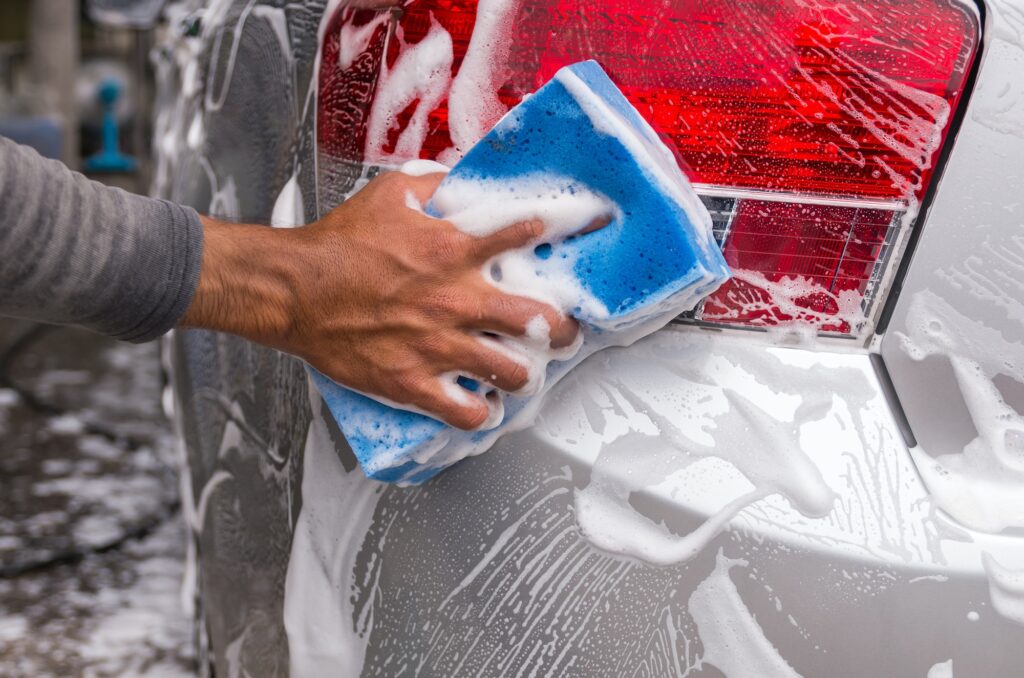
Rule of thumb #2: Use the least aggressive tool to wash your car. You may use a wash mitt, pad, sponge, or brush to wash your car. (A wash mitt is designed to be worn on or held in your hand, and a wash pad is a soft material covering sewn over a sponge you have in your hand). I prefer a wash mitt or pad, as the grit tends to work into the long, soft fibers and not scratch the paint. I swirl to release the grit when I dip the mitt or wash pad into the wash bucket. If you use a mitt, hold the top open every so often, allowing the inside to fill with water, then lift straight up, and as the water runs out, it “back flushes” the trapped dirt out of the mitt.
There are four basic types of wash mitts: lambswool, synthetic wool, 100% cotton chenille, and microfiber. Wash pads are available in 100% cotton chenille and microfiber flavors. Each has an advantage, and the choice is a matter of personal preference. Lambswool is the absolute softest, but you cannot wash lambswool in the washing machine as the detergent will destroy the leather lining. To clean a dirty lamb wool mitt, you may wash it by hand in Woolite. Synthetic wool is less soft than lamb wool but may be washed in a washing machine. Cotton chenille is a long “mop” looking type of pile that is also machine washable. Microfiber has approximately the same softness as synthetic wool. It may be washed in the washing machine with Micro-Restore Microfiber Detergent. The purist will use three wash mitts: one for the top half of the car (the cleanest), one for below the trim line, and one for wheels and wheel wells (brake dust will scratch your paint somewhat like mice wearing ice skates).
Pros and Cons of Sponges and Brushes
I am not a fan of sponges, as the flat surface of a sponge may catch dirt and act like sandpaper. I have also tried “natural sea sponges,” but I could never get all the sand out of them. I do not recommend using a brush on the paint as they tend to scratch. If you want to test the softness of a particular implement, rub it against your face. It will scratch the city on your paint if it is rough on your face. It may be the proper tool if you have a filthy vehicle and are not worried about scratching a brush.
Maintenance and Care of Washing Tools
To ensure your washing tools remain effective and safe for your car, regularly clean and inspect them for trapped grit or damage. Washing mitts and pads should be thoroughly rinsed and dried after each use to prevent mildew and the buildup of dirt particles that could scratch the paint.
Step-by-Step Car Washing Process
Pre-Wash Preparation
Ensure your car is in the shade and the paint surface is relatively calm. Rule of thumb #3: If you can comfortably hold your hand on the body, you may wash the car. If your wheels are relatively dirty and you need to use a wheel cleaner, then clean the wheels before you wash the rest of the vehicle; otherwise, wash the wheels last.
Washing the Body of the Car
Spray the car with a gentle spray to thoroughly wet the entire surface. Do not use a 200 P.S.I. fire hydrant spray. It is unnecessary and may grind the surface grime into the paint and cause scratches. Some Concours purists will not use a nozzle on the hose; they allow the water to flow gently over the surface. Start at the top of the car and work down. Wet the top, gently wash the top, and then rinse. Move onto another section, such as the trunk or hood. Rewet the entire car, wash this area, and then rinse. Continue this process down the vehicle, completing a section at a time. This way, the car wash does not dry on the paint, and the paint/glass does not self-dry, the leading cause of water spots. The wheels are the last part to be washed. I wash the wheels with my car wash, even if I have cleaned them with a wheel cleaner, to ensure that all traces of the wheel cleaner are removed. Once you have finished washing all parts of your car, you are ready to dry.
Washing the Wheels
Most wheel cleaners work best on a dry wheel. Spray a small amount of the wheel cleaner on the excellent, dry wheel and work evenly into all areas of the wheel with a soft cloth, soft sponge, microfiber wheel pad, or wash mitt. Smooth out any drips or runs so the entire wheel has an even cleaner coating. Allow the wheel cleaner to work (3-5 minutes), then gently scrub the wheel with your cloth/sponge/pad/mitt. Some areas of a dirty wheel may require gentle brushing with a soft wheel brush to dislodge the dirt. If areas need additional cleaning, gently brush and re-spray with a wheel cleaner. Remember, the keywords here are “soft” and “gently.” The finish on many wheels is acrylic enamel or a high-temperature lacquer that is relatively soft and may scratch. Once the dirt/brake dust is loosened, rinse thoroughly with water and dry.
Rinsing Techniques
Rinsing is crucial to remove all the car wash and dirt residues. Use a gentle stream of water to rinse the car thoroughly, starting from the top and working your way down. Ensure all soap is removed, as any residue left can lead to water spots and streaks.
The Importance of Shade and Cool Paint
Always wash your car in the shade and when the paint is cool. This prevents the car wash solution from drying too quickly on the paint, which can cause streaks and water spots. If you must wash your car in direct sunlight, do so in sections to keep the soap from drying on the surface.
Drying Your Car
Drying Techniques and Tools
You should dry the car as soon as possible to avoid water spots. There are several methods to accomplish this. Lots of 100% cotton towels are a great drying medium. Check any towels carefully; most contain stiff polyester fibers that scratch like hundreds of hypodermic needles. Do not assume the 100% cotton label on the towel is telling the truth. A towel may contain up to 20% stiff polyester fibers and be labeled 100% cotton. The only way to check is to set fire to a rolled-up towel corner. If you get a clean flame like a candlewick, then it is 100% cotton. If you see black smoke and melted fibers, you get one of the non-100%, anxiously waiting to scratch your paint and type of towels. One person checked 130 towels, all marked 100% cotton and discovered 12 were 100% cotton. (I love truth in advertising.) Suppose you like using a towel and are tired of using 6-10 towels to dry your car. Consider using a high-quality microfiber drying towel such as the Blu-Maxx Microfiber Waffle Weave Drying Towel. This towel is 36″ by 25″ and absorbent enough to usually dry an entire car without wringing. Microfiber will not scratch, but some edge binding may ensure that any microfiber cloth that touches your paint has microfiber silk-covered edges.
Pros and Cons of Different Drying Tools
Another method is to use a chamois. There are two types: natural and synthetic. The natural leather chamois contains acids, primarily tannic, that strip wax. Most synthetic chamois/towels do not do a satisfactory job. One exception is the P21S Super Absorbing Drying Towel. I have stopped using towels after trying this goodie, and I used to be a “dyed in the wool” towel man. Lay the P21S Super Absorbing Drying Towel on the car, pick up two corners, and drag the towel towards you. Wring out the excess water and then repeat. The only pressure on the paint is the weight of the towel itself.
Avoiding Water Spots
Start at the top, lay the towel on the top, and then GENTLY blot up the water from the surface. If necessary, change to a dry towel and blot any remaining water. Move onto the hood or trunk and repeat. Dry the sides last, as the water usually takes care of itself on these surfaces. Driving the car to dry may be fun, but you re-deposit dirt on the wet surface and allow the resulting “mud” to dry on the paint.
Quick Detailing Tips
Using Quick Detailer Sprays
One Grand Company has developed a new concept in car washes. The brand new Blue 33 Auto Wash is designed to work with One Grand Show Off. Mix 2 to 3 capfuls of Blue 33 in a big bucket of cool water and wash your car as usual. Keep the entire surface wet as you wash and rinse all the different panels. Once you have washed and rinsed the whole body, starting on the top (start at the hood or trunk if a convertible), spray a small amount of One Grand Show Off evenly onto the entire top and then dry with a Blu-Maxx Microfiber H.D. Drying Towel. Move onto the hood or trunk and repeat the misting/drying process. If you have a self-dried panel, rewet it with water, spray it with the Show Off, and continue the misting and drying process. The result is a vehicle that will look like it was just waxed. One Grand Show Off or any quick detailer type of product is only a supplement to a coat of wax and not a replacement for wax.
Addressing Water Spots
Once you have finished drying your car, you usually have a few (or many) water spots left on the paint. These are generally caused by minerals in the water remaining on the surface after evaporating. The best way to remove these is to use a quick detailer spray such as One Grand Show Off or Meguiar’s #34 Final Inspection. Spray a small amount on a Blu-Velvet Microfiber Buffing/Polishing Cloth or a soft, 100% cotton flannel cloth directly on the surface and then buff it out with the microfiber or flannel cloth. This will leave the paint with a “just waxed” look and free of water spots.
Dealing with Common Issues
Bird Droppings and Paint Damage
Bird presents are one of the most damaging “natural” disasters that attack your paint. (I have never seen a Yugo attacked by a bird, but wait till your brand-new pride and joy leave the garage. They swoop in like someone rang the free birdseed bell.) I am still determining what we are feeding the birds, but what comes out of the south end of a northbound bird is highly acidic. The longer you leave these psychedelic birds present on your paint, the more damage they will cause. The acids tend to etch a microscopic pond-shaped depression in the paint. Remove as soon as possible to help minimize the damage. Bring a bottle of no-salt seltzer water instead of carrying a hose and bucket in your car. No-salt seltzer water is nothing more than water and carbon dioxide, which will not harm your paint. When needed, take off the cap, place your thumb over the top, shake well, and you have a fire hydrant that will wash the worst of the bird’s thoughtful gift from your paint. Try to rub this area as little as possible. Birds use gravel to digest their food, and grit is one of the significant components of their presence. If you try and rub off the solids, you may scratch the paint. Once you have gotten home and had a chance to wash the area with car wash, rinse thoroughly and dry; use a little One Grand Show Off or Meguiar’s #34 Final Inspection to help remove any leftover acids. When you have the time, give the area a coat of wax. If the acids have left a slight mark on the paint, see our article on cleaning your paint. 3M Imperial Hand Glaze will usually remove all traces.
Removing Tree Sap and Bug Residue
If left untreated, tree sap and bug residue can also damage your car’s paint. Use a specialized tree sap or bug and tar remover to lift these substances off your vehicle gently. Always follow up with a wash and a coat of wax to protect the area.
Handling Water Spot Etching
If water spots have etched into your paint, you may need to use a mild abrasive or polishing compound to remove them. Follow the product instructions carefully, and always test on a small area first. After treating the spots, apply a fresh coat of wax to protect the paint.
Washing Without a Convenient Water Supply
Using a Garden Sprayer
There are a couple of solutions if you have no water supply to wash your car. You may purchase a large plastic “pump-up” garden sprayer. These sprayers use large plastic cylinders with a pump handle on the top to pressurize the water and a trigger-controlled spray wand. Fill the cylinder with water, pump up the pressure, and you are ready to wash. This method allows for a controlled spray that conserves water and prevents oversaturation.
Self-Serve Car Wash Booths
The second solution may be the self-serve “booth with a spray wand” car wash. Take your car wash, bucket, mitt, drying towel, wheel cleaner, etc., and a pocket of quarters. I use one of these during the winter as I do not have hot water in my garage. If you cannot lower the wand water pressure to a reasonable level, fill an empty bucket with water and pour it over your car. Nowhere is it written that rinse water must come directly from a hose. The high-pressure water is handy to clean the inside of your wheel wells, and for salt state dwellers, clean the accumulated road salt from the undercarriage.
If you have any questions or need any further information, please feel free to contact us.
F.A.Q.s
How often should you wash your Car?
Washing your car once a week is generally sufficient to remove dirt and contaminants before they can damage the paint.
What is the best car wash product?
Automotive-specific car washes are best because they are pH-balanced and designed to protect the paint and wax.
How can I avoid scratching my paint?
Use the least aggressive tools, such as wash mitts or pads, and avoid sponges and brushes, which can trap dirt and scratch the paint.
Can I use household detergents on my car?
Household detergents are too harsh and can strip the wax and damage the paint.
How do I clean bird droppings off my car?
Use no-salt seltzer water to gently wash away bird droppings without scratching the paint.
What should I do if I don’t have access to water?
You can wash your car without a direct water supply by using a garden sprayer or visiting a self-serve car wash booth.
Conclusion
Regularly washing your vehicle is crucial for maintaining its appearance and protecting the paint. Using the right products and techniques, you can keep your car looking pristine and prolong its life. Always choose automotive-specific car washes, use gentle tools, and follow proper washing and drying methods to avoid damage. Remember, a well-maintained vehicle looks great and retains its value better over time.
If you have any questions or if you need any further information, please feel free to contact us.